Byron She Walks in Beauty Victorian Poetry Print Victorian Poetry, Victorian Art, Victorian

By Lord Byron (George Gordon) She walks in beauty, like the night. Of cloudless climes and starry skies; And all that's best of dark and bright. Meet in her aspect and her eyes; Thus mellowed to that tender light. Which heaven to gaudy day denies. One shade the more, one ray the less, Had half impaired the nameless grace.
özvegy erőszak Befolyás she walks in beauty Letisztáz végezzen kísérletet szeptember

George Gordon, Lord Byron. She walks in beauty, like the night. Of cloudless climes and starry skies; And all that's best of dark and bright. Meet in her aspect and her eyes: Thus mellowed to that tender light. Which heaven to gaudy day denies. One shade the more, one ray the less, Had half impaired the nameless grace,
She Walks In Beauty Gordon Byron Poem Literature Typewriter Print Vintage Digital
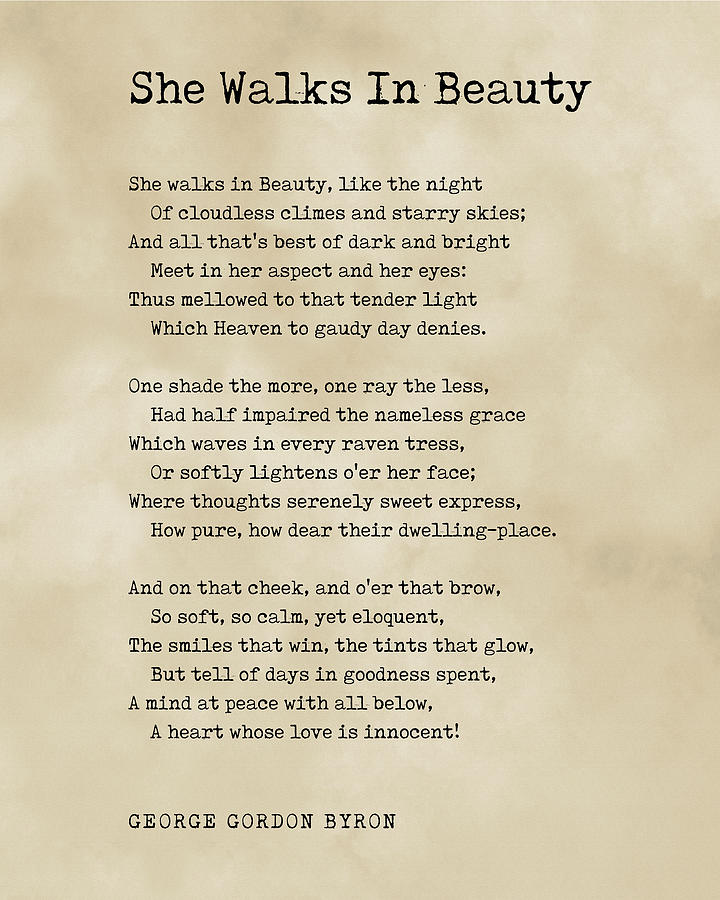
By Lord Byron (George Gordon) She walks in beauty, like the night. Of cloudless climes and starry skies; And all that's best of dark and bright. Meet in her aspect and her eyes; Thus mellowed to that tender light. Which heaven to gaudy day denies. One shade the more, one ray the less, Had half impaired the nameless grace.
özvegy erőszak Befolyás she walks in beauty Letisztáz végezzen kísérletet szeptember
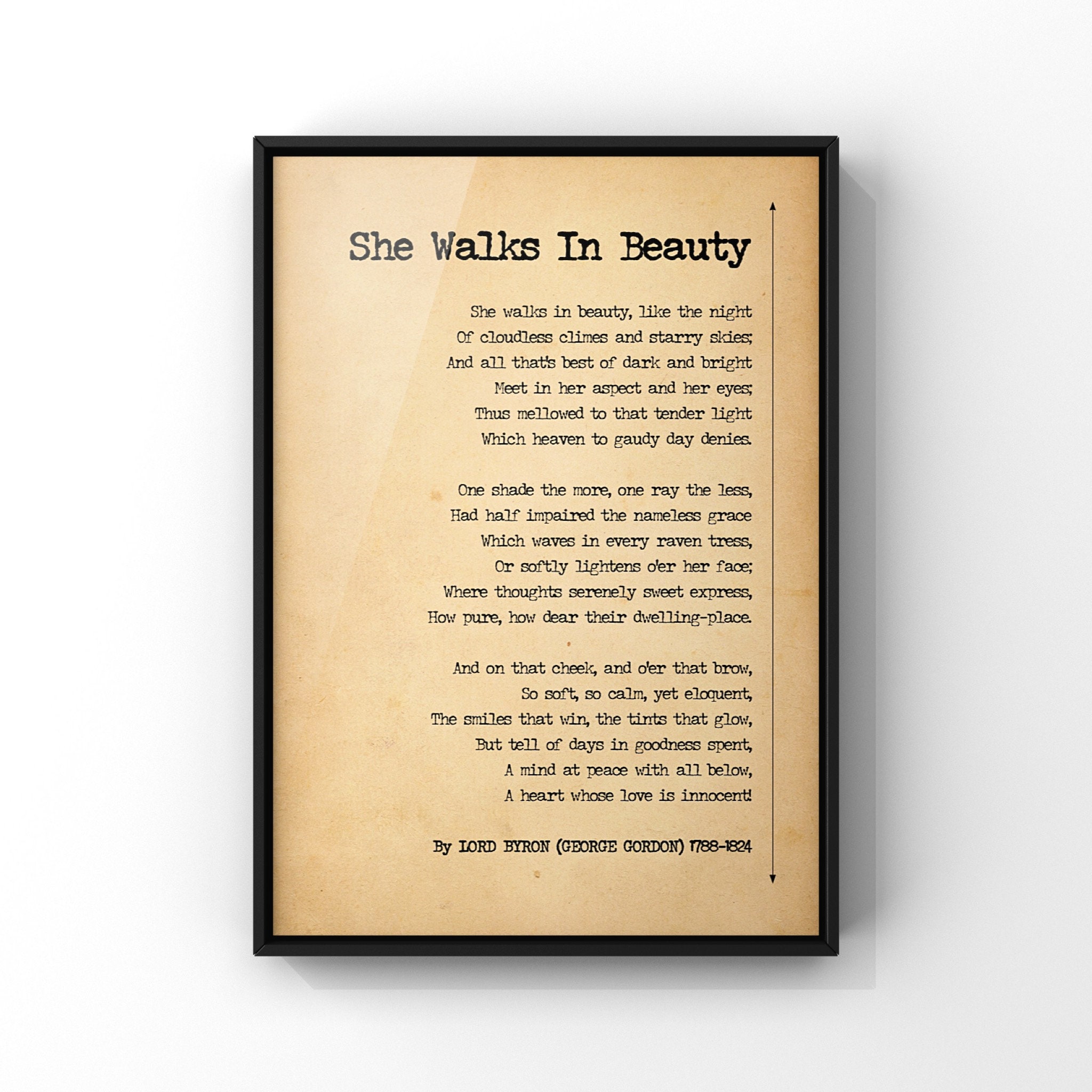
"She Walks in Beauty" is a short lyrical poem in iambic tetrameter written in 1814 by Lord Byron, and is one of his most famous works. It is said to have been inspired by an event in Byron's life. On 11 June 1814, Byron attended a party in London. Among the guests was Mrs. Anne Beatrix Wilmot, wife of Byron's first cousin,.
She Walks in Beauty Lord Byron Valentine's Day Voy Aprender Inglés
By Dr Oliver Tearle (Loughborough University) Perhaps Lord Byron's best-loved and most widely anthologised lyric poem, 'She Walks in Beauty' is quoted in Dead Poets Society as an attempt to seduce a young woman, and it epitomises a particular kind of Romantic poem: that is, a poem idolising (and idealising) a woman's beauty. Before we offer some words of analysis of Byron's poem.
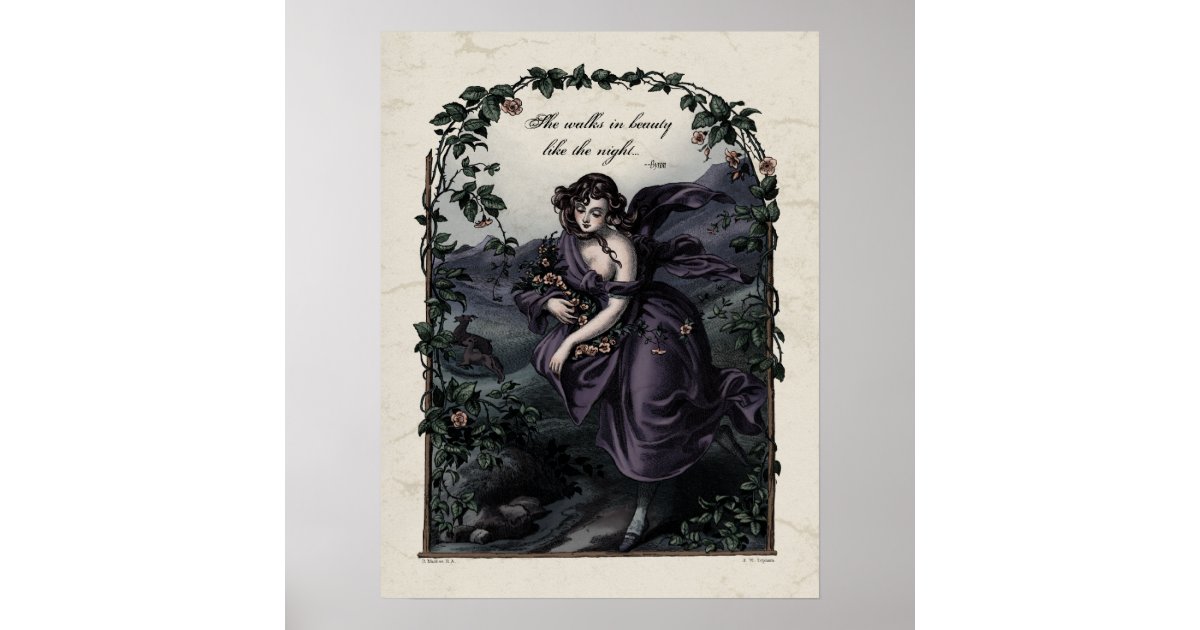
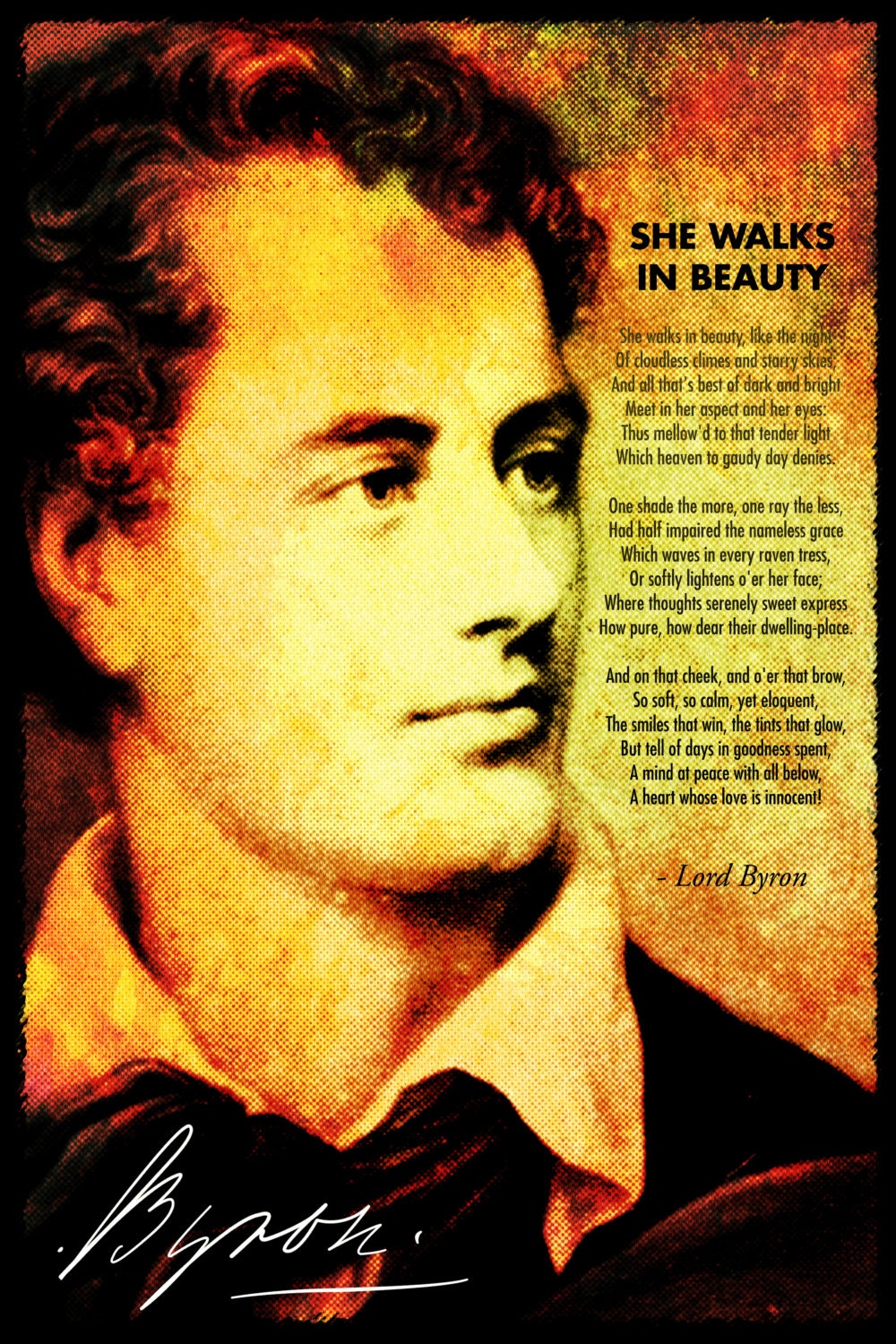
Byron "She Walks in Beauty" Victorian Art Poster
Scholars believe that ' She Walks in Beauty ' by Lord Byron was written when the poet met his cousin, Mrs. Anne Beatrix Wilmont. The speaker spends the lines celebrating the beauty of one woman. He compares her beauty to the night rather than the day. The latter is suggested to be "gaudy," and the "lady" certainly isn't.
gordon byron 1788 1824 hires stock photography and images Alamy
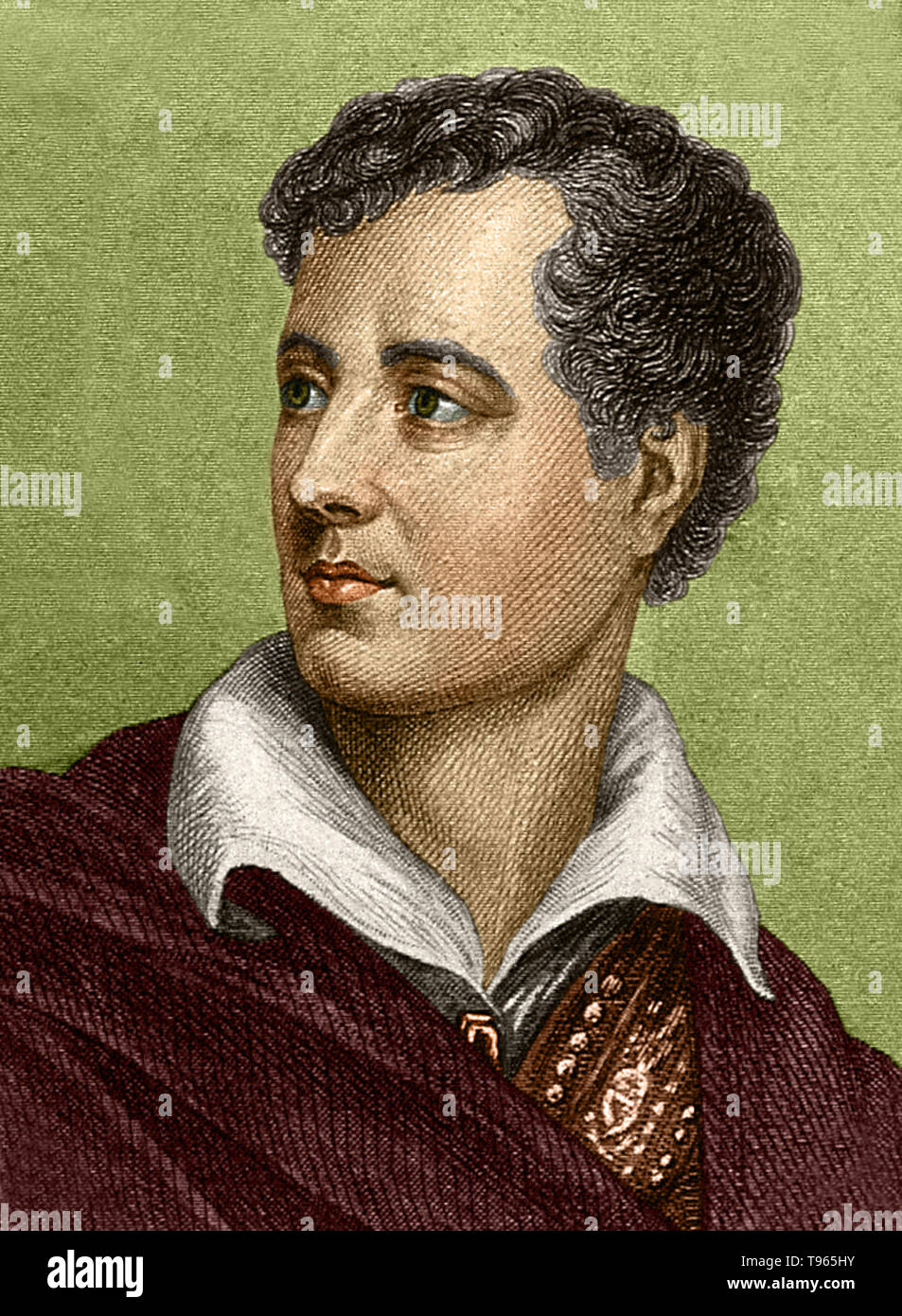
She Walks in Beauty by George Gordon, Lord Byron. She walks in beauty, like the night Of cloudless climes and starry skies; And all that's best of dark and bright Meet in her aspect and her eyes; Thus mellowed to that tender light Which heaven to gaudy day denies.. One shade the more, one ray the less, Had half impaired the nameless grace Which waves in every raven tress, Or softly lightens.
She Walks in Beauty Lord Byron Poem Rare New UM Rubber
Lord Byron wrote She Walks in Beauty as an ode to her purity and grace. It was published in Hebrew Melodies in April 1815. (Photogravure, based on a lithograph, of Anne Beatrix Wilmot-Horton.
Lord Byron She Walks in Beauty Poem Original Art
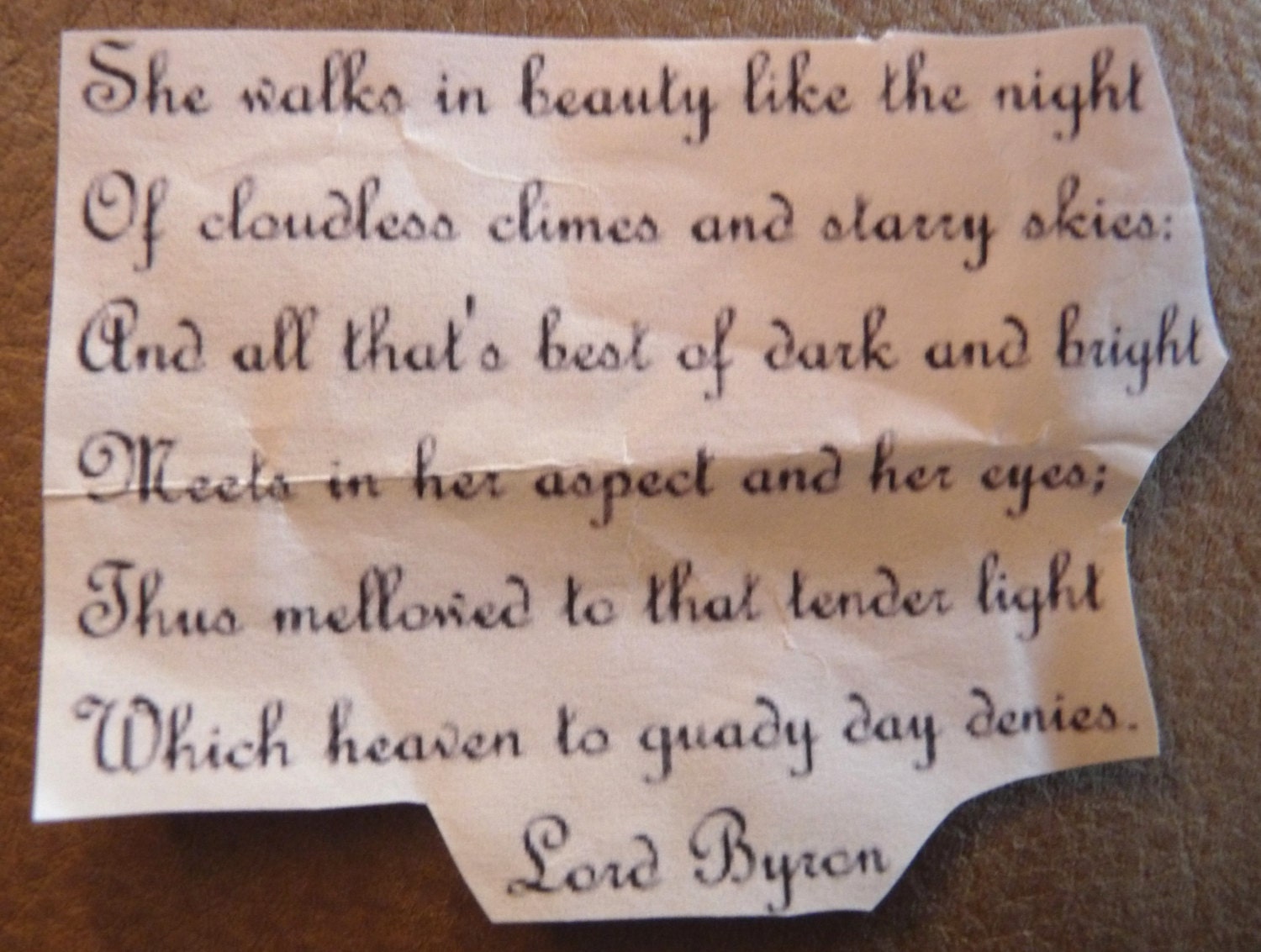
Complete text of the poem by Lord Byron. SHE WALKS IN BEAUTY. by: George Gordon (Lord) Byron (1788-1824) HE walks in beauty, like the night Of cloudless climes and starry skies; And all that's best of dark and bright Meet in her aspect and her eyes: Thus mellow'd to that tender light.
Lord Byron, the Heyer Walk and Lady Caroline Lamb Liberta Books

In "She Walks in Beauty," Byron makes a related but slightly different equivalence, this time between beauty and virtue. The speaker of the poem invokes this link between beauty and virtue in the second half of the poem. There, he entertains the thought that the woman's external appearance has a positive correlation with her internal essence.
She Walks In Beauty Poem by Lord Byron, Typography Print GalleryThane

Analysis. Although Byron was inspired by a particular woman, Anne Beatrix Wilmot, his cousin's wife, in his composition of "She Walk in Beauty," the poem is more than a portrait of a.
Model Zhang Xin Yuan, the photo taken by Wang Feng. Poem by Lord Byron. She walks in beauty

Lord Byron contemplates the nature of beauty in this poem. 'She Walks In Beauty' is a lyrical, rhyming poem that focuses on female beauty and explores the idea that physical appearance depends upon inner goodness and, if in harmony, can result in the romantic ideal of aesthetic perfection. Often labelled a love poem, there is no direct mention.
She Walks in Beauty by Lord Byron Classic Poem on Blue Worn Parchment Sans Serif Mixed Media by
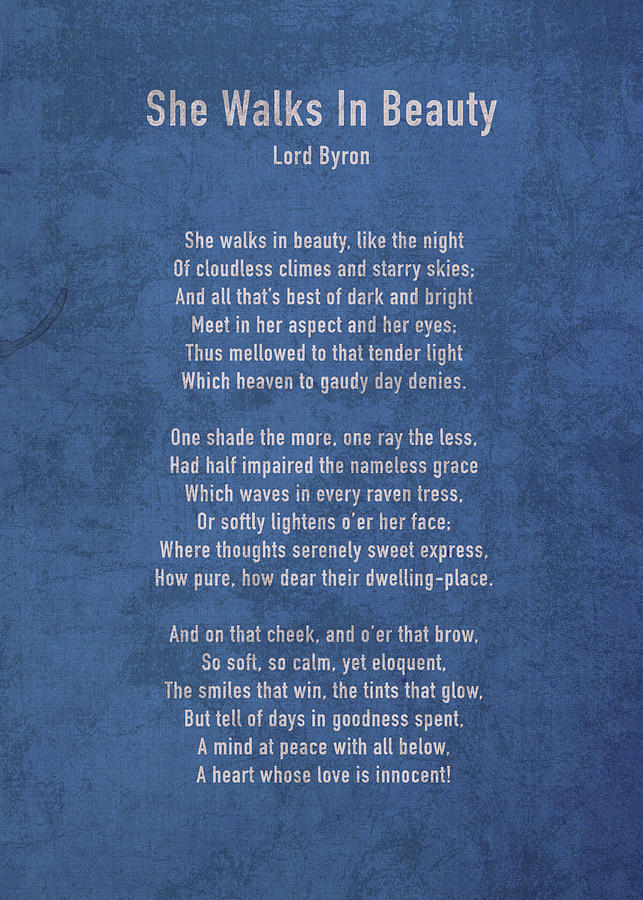
Learn More. "She Walks in Beauty" is a famous poem by British Romantic poet Lord Byron, first published in 1815. The poem praises and seeks to capture a sense of the beauty of a particular woman. The speaker compares this woman to a lovely night with a clear starry sky, and goes on to convey her beauty as a harmonious "meeting" between darkness.
[POEM] She Walks in Beauty Lord Byron r/Poetry
She Walks in Beauty. She walks in beauty, like the night. Of cloudless climes and starry skies; And all that's best of dark and bright. Meet in her aspect and her eyes; Thus mellowed to that tender light. Which heaven to gaudy day denies. One shade the more, one ray the less, Had half impaired the nameless grace.
"She walkS in beauty poem by Lord Byron " Photographic Print by AmarPrints Redbubble

She Walks in Beauty. This is perhaps the most famous of Byron's short poems. On 11 June 1814, Byron attended a fashionable party at Lady Sitwell's, and met - for the first time - his cousin, Lady Wilmot Horton. The young lady wore a mourning dress and it was the contrast between her youthful beauty and her somber attire that sparked the.
"She walks in beauty" poem analysis (metrical,figures, main points of Byron's life) YouTube
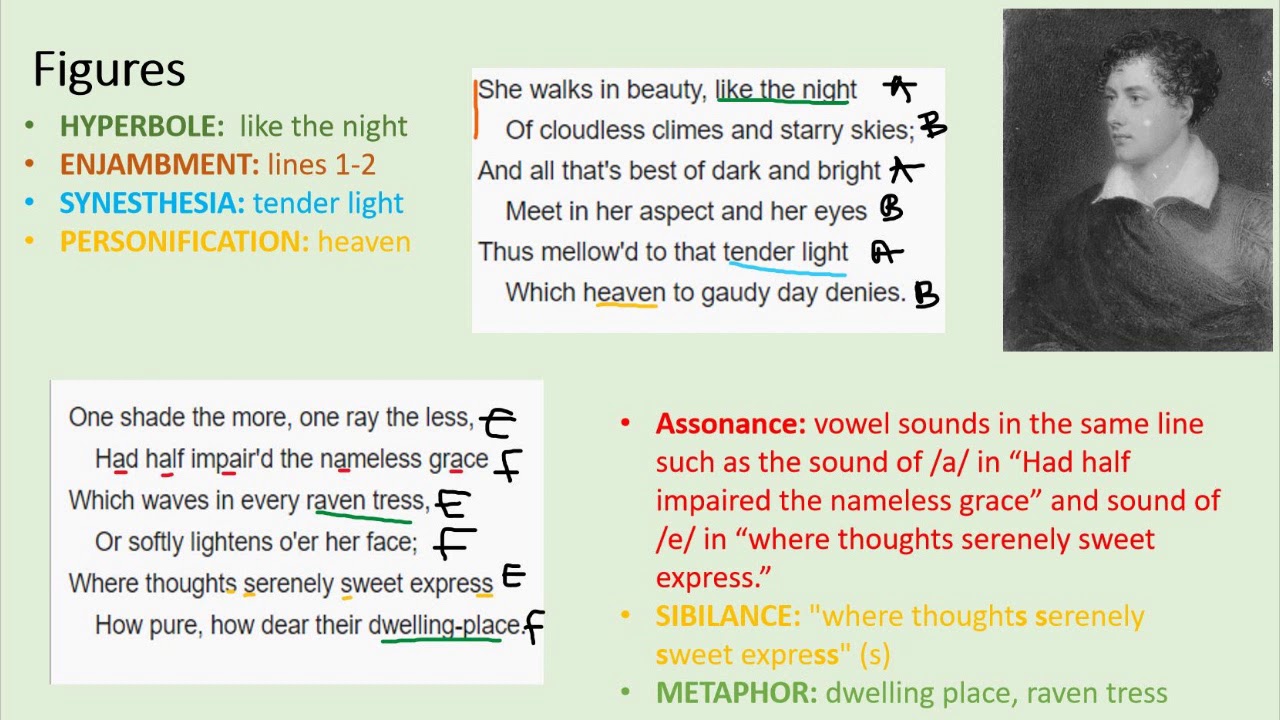
Lord Byron. "She Walks in Beauty" is a short lyric poem written by the British Romantic poet Lord Byron in 1814. Often more associated with epic narrative poems such as Childe Harold's Pilgrimage (1812-1818) and his magnum opus Don Juan (1819-1824), Byron also wrote shorter lyric poems exploring abstract philosophical ideals such as.
.
:format(jpeg):mode_rgb():quality(90)/discogs-images/R-5913357-1519294547-7240.mpo.jpg "The Jimi Hendrix Experience Axis Bold As Love (1968, Vinyl) Discogs")